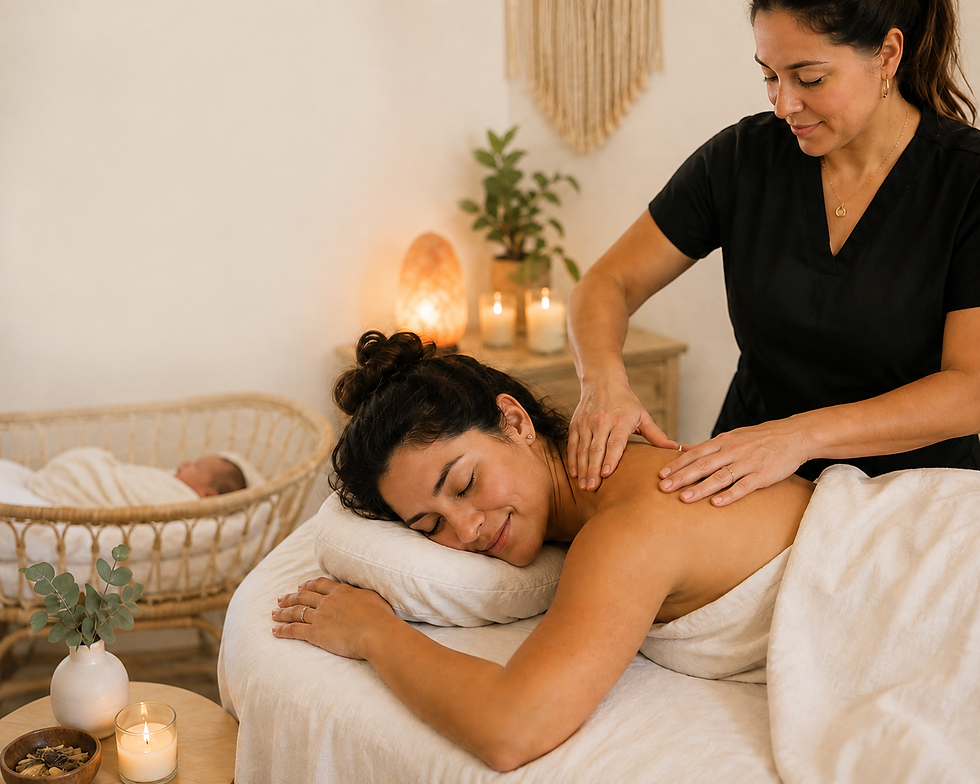
Postpartum Massage for Breastfeeding Neck & Shoulder Pain in San Diego


You finally get your baby settled into a feeding position.
Then 20 minutes later, you realize your shoulders are practically touching your ears, your neck is bent forward, your upper back is aching, and one arm has been holding the same position the entire time.
Then you do it again a few hours later.
And again.
For new mothers, breastfeeding, pumping, bottle-feeding, carrying, rocking, and looking down at baby can place an enormous amount of repetitive strain on the upper body.
If your neck, shoulders, or back have become increasingly tight since giving birth, postpartum massage in San Diego may be a supportive way to help your body relax and recover while you adjust to the physical demands of caring for your baby.
At Rebirth Maya Massage in Mission Valley, our postpartum massage is specifically designed around the needs of new mothers—not simply a regular massage with a different name.
Why Does Breastfeeding Cause Neck and Shoulder Tension?
Breastfeeding itself is not necessarily the problem.
The issue is often the position you remain in while feeding, especially when you are feeding frequently throughout the day and night.
A new mom may spend hours every day:
Looking down at baby
Rounding the shoulders forward
Leaning toward the breast instead of bringing baby toward her
Holding one arm in a fixed position
Sitting without back support
Feeding in bed at night
Carrying baby on the same side
Pumping while looking down
Rocking or bouncing baby
Leaning over a bassinet or changing table
These small movements may not seem significant individually, but repetition adds up.
ACOG recognizes back, neck, and joint pain as common postpartum symptoms and specifically recommends relaxing the shoulders, supporting the arms with pillows, supporting the back, and avoiding constantly looking downward during breastfeeding.
The “Breastfeeding Hunch”
Many new moms develop what we sometimes describe as a breastfeeding hunch.
You may notice yourself sitting with:
Your head pushed forward
Your chin tilted down
Your shoulders rounded
Your upper back curved
Your elbows held close to your body
Your chest and shoulders feeling tight
This posture makes sense.
You are trying to see your baby, monitor the latch, support their head, and keep them close.
But maintaining the position repeatedly can cause muscles around the neck, shoulder blades, and upper back to work much harder than usual.
The result can be knots, stiffness, headaches, burning between the shoulder blades, or that constant feeling that you need someone to rub your shoulders.
Why New Moms Feel Upper-Back Pain Even When They Are Not Breastfeeding
Breastfeeding is only part of the picture.
Once your baby arrives, your upper body suddenly has an entirely new job.
You're lifting baby out of the crib.
Carrying a car seat.
Holding baby while walking around the house.
Leaning over during diaper changes.
Rocking them to sleep.
Holding them against your chest.
Pushing a stroller.
And often doing all of it while sleep-deprived.
Your muscles are adapting to repetitive tasks they were not doing before.
At the same time, your abdominal and core muscles are still recovering from pregnancy and birth, which can change the way the rest of your body carries load.
ACOG notes that postpartum neck and back discomfort can be related to muscle strain, abdominal muscle weakness, and hormonal changes during and after pregnancy.
How Can Postpartum Massage Help?
Massage cannot fix every cause of postpartum pain, and significant or persistent symptoms should be discussed with your healthcare provider.
However, postnatal massage may help address muscular tension that develops from feeding, holding, and caring for your baby.
A session can focus specifically on the areas working hardest.
Neck and shoulders
The muscles of the neck and upper shoulders can become tight from looking down and supporting baby for long periods.
Therapeutic massage may help these areas soften and allow the shoulders to settle away from the ears.
Upper back
The area between the shoulder blades often becomes particularly tense when the shoulders repeatedly round forward.
Massage can focus on the muscles around the shoulder blades and upper spine to help relieve that “knotted” feeling many new moms experience.
Arms and forearms
Holding baby, pumping, and feeding can also fatigue the arms.
For some mothers, working on the forearms, hands, and upper arms is surprisingly relieving.
Low back and hips
Your feeding posture does not affect only the upper body.
Sitting for long periods or favoring one side can also contribute to low-back and hip tension.
A full postpartum massage can address the entire pattern rather than only the area that hurts most.
Postpartum Massage Is Different From Prenatal Massage
During pregnancy, massage is adapted around a growing belly and pregnancy-specific positioning.
After delivery, the priorities change.
Now we consider:
Your birth experience
How recently you delivered
Whether you had a vaginal or cesarean birth
Whether you are breastfeeding or pumping
Breast tenderness or engorgement
Healing incisions or stitches
Feeding posture
Sleep deprivation
Areas of muscular tension
Your comfort lying on the table
At Rebirth Maya Massage, our Postnatal Massage is customized specifically for new moms and may range from relaxing to therapeutic pressure depending on what your body needs.
Can You Get a Massage While Breastfeeding?
In most uncomplicated situations, yes.
Breastfeeding itself does not prevent you from receiving a postpartum massage.
However, there are several things that can make your appointment much more comfortable.
Feed or pump shortly before your appointment
If your breasts tend to become full quickly, feeding or pumping before your session may make it much more comfortable to lie down.
Tell your therapist that you are breastfeeding
This helps us choose appropriate positioning.
If lying face down puts uncomfortable pressure on your breasts, we can modify the massage.
Bring breast pads if needed
Leaking during massage can happen, especially during the early postpartum months.
There is no need to feel embarrassed about it.
Ask for different positioning
Side-lying or supported positioning may feel much better if you are recently postpartum, recovering from a C-section, or experiencing breast tenderness.
Your massage should accommodate your body.
Breastfeeding Position Can Make a Big Difference
Sometimes changing a few small habits while feeding can reduce the amount of strain building up between massages.
The NHS recommends getting comfortable before feeding, using pillows or cushions when necessary, relaxing the shoulders and arms, and bringing baby toward the breast rather than leaning your body forward toward baby.
ACOG similarly recommends keeping the back supported, supporting the arms with a pillow, relaxing the shoulders, and looking up periodically rather than keeping the neck bent downward throughout an entire feeding.
Try thinking:
Bring baby to you—not you to baby.
That one small adjustment can reduce how much you fold your upper body forward.
Try Different Breastfeeding Positions
You do not have to use the exact same position for every feed.
Changing positions may distribute the physical workload differently.
Common breastfeeding positions include:
Cradle hold
Cross-cradle hold
Side-lying
Laid-back breastfeeding
Football or rugby hold
The NHS notes that side-lying and rugby-style holds can be especially useful after a C-section because they can avoid placing pressure directly across the abdominal incision.
Different positions may also allow your neck, shoulders, and back to rest differently throughout the day.
If you're struggling with latch, nipple pain, milk transfer, or finding a comfortable feeding position, an IBCLC or other qualified lactation professional can provide individualized guidance.
Massage is not a substitute for lactation support.
What About Pumping Posture?
Pumping can create many of the same issues as nursing.
Women often sit forward while watching the pump, checking bottle volume, or adjusting the flanges.
If you pump several times per day, try to create a setup that allows you to sit back instead.
Support your:
Low back
Forearms
Feet
Neck
Pump equipment
Bring the pumping setup toward you rather than bending toward it.
If possible, place the bottles and pump where you can see them without holding your neck in a downward position for the entire pumping session.
Can Postpartum Massage Help Headaches?
Sometimes upper-neck and shoulder tension contributes to headaches.
Massage may help when headaches are connected to muscular tightness.
However, new or severe headaches during the postpartum period should never automatically be assumed to be muscle tension.
ACOG identifies a headache that does not improve—particularly when accompanied by vision changes, dizziness, or other concerning symptoms—as something that may require urgent postpartum medical evaluation.
If your headache feels unusually severe, sudden, or different from your normal tension headaches, contact your healthcare provider.
What Is the Milky Way Add-On at Rebirth?
Rebirth also offers our Milky Way add-on, a 30-minute upper-body lymphatic-focused treatment created for breastfeeding mothers.
It focuses on the upper body and lymphatic areas and can be added to a massage session.
This treatment is different from deep therapeutic massage.
Lymphatic techniques use much lighter, rhythmic pressure.
If you have breastfeeding concerns such as:
Persistent breast pain
Fever
Redness
Suspected mastitis
Significant engorgement that is not improving
Nipple trauma
Feeding difficulty
Concerns about milk supply
contact your physician, midwife, or lactation professional.
ACOG recommends evaluation and specialized lactation support when breastfeeding pain or feeding problems persist.
Can Massage Increase Breast Milk Supply?
This claim needs to be handled carefully.
Relaxation, comfort, and supportive touch may feel beneficial during breastfeeding, but massage should not be promised as a guaranteed way to increase milk production.
Milk production is primarily driven by effective and frequent milk removal, along with many individual maternal and infant factors. The CDC explains that milk production responds to milk removal through breastfeeding.
If you are concerned about low milk supply, the right first step is evaluation by a lactation professional or healthcare provider.
At Rebirth, our role is complementary wellness support.
We can help you relax, address muscular tension, and provide nurturing bodywork—but we do not replace breastfeeding medicine or lactation care.
When Can You Start Postpartum Massage?
After an uncomplicated delivery, gentle postpartum massage may be appropriate relatively early when you feel physically ready and medically stable.
At Rebirth, our Postnatal Massage can be scheduled according to your comfort and recovery needs.
However, the type of massage matters.
A shoulder and upper-back massage is very different from:
Direct C-section scar work
Deep abdominal massage
Postnatal womb massage
Pelvic bodywork
Those services have different healing timelines.
If you had a complicated delivery, significant bleeding, infection, high blood pressure, blood-clot concerns, or other postpartum complications, talk with your healthcare provider before scheduling massage.
What If You Had a C-Section?
You can still experience plenty of neck and shoulder tension after a cesarean birth.
In fact, feeding and caring for baby while protecting a healing abdominal incision can cause you to compensate even more through your upper body.
Massage can be positioned so that there is no uncomfortable pressure across your abdomen.
Options may include:
Side-lying massage
Supported semi-reclined positioning
Gentle upper-body work
Shoulder and neck massage
Arm and hand massage
Modified full-body postpartum massage
Our therapist should always know how recently you delivered and how your incision is healing.
Rebirth also offers a separate Cesarean Birth Massage, which uses very light lymphatic techniques and is different from a standard therapeutic massage.
When Neck or Shoulder Pain Needs Medical Care
Most new-mom muscular tension is not an emergency.
But massage should not be used to mask symptoms that need medical evaluation.
Contact your healthcare provider if you experience:
Severe or worsening neck or back pain
Numbness or tingling that persists
Significant weakness in an arm or hand
Chest pain
Shortness of breath
Fever
Severe headache
Vision changes
Pain following an injury
Symptoms that are not improving
Any postpartum symptom that concerns you
Your provider may recommend physical therapy if postpartum neck, back, or joint pain persists. ACOG specifically notes physical therapy as one possible option for postpartum musculoskeletal pain.
Massage and Physical Therapy Can Work Together
Massage and physical therapy serve different purposes.
A massage therapist primarily works with muscular and soft-tissue tension, relaxation, and comfort.
A physical therapist can assess:
Posture
Muscle weakness
Movement patterns
Core recovery
Joint mobility
Nerve symptoms
Pelvic-floor function
Functional movement
If your discomfort keeps returning despite massage, combining therapeutic bodywork with physical therapy may be especially helpful.
There does not have to be only one solution.
Simple Ways to Reduce Breastfeeding Neck and Shoulder Tension at Home
Between massage appointments, try these small changes:
Support your elbows
Use pillows so your shoulders do not have to hold the weight of your arms and baby during every feed.
Support your low back
Place a cushion behind you instead of sitting unsupported.
Relax your shoulders
Every few minutes, check whether your shoulders have crept toward your ears.
Allow them to drop.
Look forward periodically
You do not need to watch baby every second of a long feed.
Once baby is feeding safely, periodically bring your head back to neutral.
Switch sides for carrying
If you always carry baby on your dominant side, the same shoulder and hip absorb the workload all day.
Switch when practical.
Bring baby higher
Use pillows or feeding supports so you do not have to lean down toward your baby.
Change feeding positions
Giving your body different positions throughout the day may reduce repetitive strain.
How Often Should a New Mom Get Postpartum Massage?
There is no single ideal schedule.
Some moms book when the tension becomes noticeable.
Others find regular postpartum massage helpful during the first several months because their bodies are constantly adapting as baby grows.
You might consider more regular massage if you:
Breastfeed or pump frequently
Carry baby for long periods
Work at a computer in addition to caring for baby
Have an older child you also carry
Develop recurring neck and shoulder tension
Have difficulty relaxing
Feel physically exhausted
Notice massage relief but the tension gradually returns
Your massage frequency can always change as your baby grows and your body adjusts.
Why Choose Rebirth for Postpartum Massage in San Diego?
Rebirth Maya Massage is a women-centered wellness center in Mission Valley specializing in care throughout fertility, pregnancy, birth, and postpartum recovery.
Our postnatal massage is designed specifically around what new moms are actually experiencing.
That may mean spending more time on your:
Neck
Shoulders
Upper back
Low back
Hips
Arms
Hands
Rather than following one identical full-body routine, your session can focus on the areas that need the most attention.
Rebirth offers both 50- and 80-minute postnatal massage options, along with specialized postpartum services and enhancements.
You Spend All Day Taking Care of Someone Else
This is one of the biggest reasons we believe postpartum massage matters.
Once a baby arrives, mothers can quickly disappear from their own list of priorities.
Someone needs to eat.
Someone needs a diaper.
Someone needs to sleep.
Someone needs to be held.
And that someone is usually the baby.
Meanwhile, your shoulders hurt.
Your neck is tight.
You're exhausted.
And you keep telling yourself you'll take care of it later.
Postpartum care should include the mother too.
An hour of massage will not eliminate the demands of new motherhood, but it can give your body a much-needed opportunity to soften, rest, and receive care.
Looking for Postpartum Massage in San Diego?
If breastfeeding, pumping, feeding, or carrying your baby has left your neck and shoulders feeling tight, postpartum massage in San Diego may be a supportive addition to your recovery routine.
At Rebirth Maya Massage in Mission Valley, our postnatal sessions are customized around your birth recovery, feeding routine, comfort level, and areas of muscular tension.
You do not have to wait until your body is completely exhausted to take care of yourself.
Book your postpartum massage at Rebirth Maya Massage in San Diego and let someone take care of you for a change.
This article is for educational purposes and does not replace medical or lactation advice. Persistent pain, breastfeeding difficulties, or unusual postpartum symptoms should be evaluated by your OB-GYN, primary-care provider, physical therapist, or qualified lactation professional.
Frequently Asked Questions
Can breastfeeding cause neck and shoulder pain?
Feeding positions can contribute to neck and shoulder tension, particularly when you repeatedly look down, lean forward, round the shoulders, or hold your arms without support. ACOG recommends supporting the back and arms and relaxing the shoulders during breastfeeding.
Can I get a massage while breastfeeding?
In most uncomplicated situations, yes. Tell your therapist you are breastfeeding so your positioning can be adjusted. Feeding or pumping shortly before your appointment may make the session more comfortable.
What areas should postpartum massage focus on for breastfeeding moms?
Common areas include the neck, shoulders, upper back, arms, forearms, low back, and hips. Your massage should be customized according to where you feel tension.
Should I pump before my massage?
You do not have to, but feeding or pumping before your appointment may make lying down more comfortable if your breasts become full or tender.
Can postpartum massage improve milk supply?
Massage should not be presented as a guaranteed treatment for low milk supply. If you are concerned about milk production, speak with an IBCLC or healthcare provider.
What massage is best for breastfeeding shoulder pain?
A customized postpartum massage that addresses the neck, upper back, shoulders, and arms may be helpful for muscular tension. Persistent, severe, or neurological symptoms should be medically evaluated.
Where can I get postpartum massage in San Diego?
Rebirth Maya Massage offers specialized postpartum and postnatal massage in Mission Valley, San Diego, with sessions personalized for new moms, including breastfeeding-related neck, shoulder, and upper-back tension.